Showing posts with label Presentations. Show all posts

Overview of Challenges Experienced by Small Farmers in Engaging with Markets
Overview of Challenges Experienced by Small Farmers in Engaging with Markets, by Mr. Nonoy Villas, presented the rationale behind supporting small farmers’ commodity-based associations. He started with the definition of terms to illustrate that the small farmers have the weakest link in both the supply and the value chains.

He added that small farmers are much weaker now than 15 years ago due to many changes such as changes in the global agricultural market, changes in national government, increasing urbanization, emergence of new market segments, and the ever-increasing challenges of economies of scale. He enumerated the various types of small-farmer commodity organizations, their roles and functions, and some of the specific challenges (for instance, the investment requirements governing cooperatives) that each of them might soon have to address.

Mr. Villas concluded with a discussion on the emergence of pockets of changes and possibilities (some in advanced stages, some new ones) that can serve as models in inspiring and encouraging more initiatives to consolidate commodities and scale up operation so that the small farmholders can have a strong voice in the market.

Download the Overview of Challenges Experienced by Small Farmers in Engaging with Markets

Read More...
AddThis Social Bookmark Button

High Quality Products at Higher Prices: The Experience of TWADA

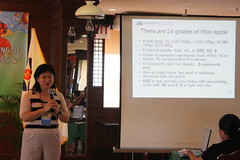
High Quality Products at Higher Prices: the Experience of TWADA which was presented by Dr. Wen Chi Hwang, General Secretary of the said organization, explained about the experience of marketing based on product strength, quality, and competitive advantage. She narrated the history of TWADA as already having started with not just individual farmers but with small, organized groups of wax apple growers.

The technology for product development and improvement was already there, developed with huge government support. TWADA was organized specifically for the purpose of expanding the market. Dr. Hwang narrated TWADA’s marketing initiatives which included joint marketing with the top three biggest consumer market in Taiwan, door-to-door marketing, direct marketing through the internet, and export trading. She narrated the benefits received from these strategies, which included, among others, higher and more stable farm gate price for farmers, and generally a higher income for all of them.

Dr. Hwang further discussed the challenges and issues confronted by TWADA in marketing their product, and how these are being addressed. The challenges include seasonality of export, economy of scale, professional grading of product, and packaging. TWADA’s biggest buyers are its local markets, while its biggest buyer abroad is China. TWADA is also trying enter the Singaporean and Hongkong market, and recently, it has been able to break into the Canadian market.

Download High Quality Products at Higher Prices: The Experience of TWADA

Read More...
AddThis Social Bookmark Button

Addressing Product Consolidation to Achieve Scale, Product Quality and Food Safety and Marketing

Addressing Product Consolidation to Achieve Scale, Product Quality and Food Safety and Marketing by Mr. Seo Dong Woo of Korean Pear Producer’s Association discussed about the history of the said organization, and its structure and support systems. He explained that in Korea, village-based commodity units are organized into commodity associations by Nong Hyap national cooperative to gain negotiating power in the market and to get more technical inputs and support. Government helps promote their activities by giving subsidies, investing money, and providing machines for farms.

Mr. Woo proceeded to explain the Korean market conditions and strategy, including online selling and the establishment of a storage facility for each of the commodity association. He said that their production strategy is similar to the GAP system in Taiwan in terms of practices in quality control. He added that the Korean Pear Producers’ Association undertakes continuous effort to improve their product quality, tie up with government services, and diversify markets.

Download Addressing Product Consolidation to Achieve Scale, Product Quality and Food Safety and Marketing (English)


Download Addressing Product Consolidation to Achieve Scale, Product Quality and Food Safety and Marketing (Korean)

Read More...
AddThis Social Bookmark Button

Summary of Basic Requirements for a Successful Small Farmers Engagement with Markets

Summary of Basic Requirements for a Successful Small Farmers Engagement with Markets resulted from a collective effort of the participants, upon facilitation by Ms. Lany Rebagay. In developed countries, a key factor is government support.

But for those countries whose government provide only little, if not almost no, assistance, the farmers themselves should organize and consolidate to attain bargaining power. Other basic requirements for a successful small farmers engagement with market include: high product quality (internal quality controls) and product promotion, scientific methods in linking with and positioning in the market (eg identification of one’s competitive advantage), production efficiency, volume, large area for expansion, business systems for efficient administrative and finance operations, and human resource development (especially democratic leadership).

Read More...
AddThis Social Bookmark Button

Experiences of Small Cassava Farmers in Bukidnon

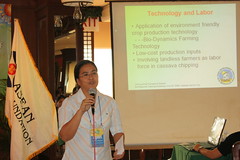
Experiences of Small Cassava Farmers in Bukidnon, presented by Ms. Agnes Bolaños, Executive Director, Agri-Aqua Coalition for Development- Mindanao, related about the case of Balugo farmers’ Multi-purpose Cooperative in supplying cassava chips and by-products to San Miguel Corporation, one of the biggest food and beverage processing company in the Philippines.

She explained the scope and volume requirements of the trading and how the small farmholders are organized to meet this market’s demands. Ms. Bolaños said that the farmer s have proven that the use of organic farming method (due to its low-cost inputs and nourishment of soil) is the most beneficial, profitable, and reliable method of production.

She also said that commodity consolidation is very important as it is very difficult to negotiate if one could not comply with the volume requirements of the market. Finally, she related that the private sector has been showing interest in developing communities but don’t know how and where to begin. Civil society can help in providing linkage, direction, and concrete proposals that the private sector can consider.

Download Experiences of Small Cassava Farmers in Bukidnon

Read More...
AddThis Social Bookmark Button

Enhancing the Competitiveness of Small Farmers

Enhancing the Competitiveness of Small Farmers by was given by Mr. Jing Pacturan, Executive Director Philippines Development Assistance Program. He started the session with a competitive game which simulated the dynamics of market in the real world. Based on the experience of the game, he drew the participants’ insights about entrepreneurship, management, and leadership. He proceeded to discuss the various stages of development of rural communities (from survival, to productivity, to growth).

He dwelt on the need to go beyond increase in productivity by moving toward enterprise development. Ms. Pacturan also discussed the various challenges to LSFM which includes the trend of agriculture becoming a major part of globalized trading, the rise of supermarkets, the preference for healthy foods and organic products and climate change. He reviewed the factors affecting small farmer participation in the supply chain, and the need to see the importance of really having impact on the value chain.

He discussed the information flow, principal focus, strategy, orientation, organizational structure and the philosophy of moving towards this direction. He emphasized that any relationship should be able to ensure equitable distribution. He discussed market participation approaches and some of the more successful examples of community initiatives in mainstream markets (namely, Don Bosco Foundation in South Cotabato on biodynamic technology, Muscovado farmers in Sultan Kudarat, and Pecuaria in Bicol Province).


Download Enhancing the Competitiveness of Small Farmers

Read More...
AddThis Social Bookmark Button